


.jpg)
Series 1: The Transition Opportunity
The Transition Opportunity is a series that reframes the global transition as a capital allocation opportunity, not a moral imperative. It provides a clear, structured overview of the green economy sectors attracting private and institutional investment, explaining how each sector functions, where value is created, and why capital is flowing unevenly across the transition landscape.
Article 2: The Capital Mechanics of the Transition Backbone
Article 1 of The Transition Opportunity set out the structure of the transition economy. The next question for investors is practical: how does capital actually convert into revenue once it is deployed?
The transition is executed through a backbone of physical assets that absorb large amounts of upfront capital and generate cash flows over multi-decade horizons. Returns are determined by how revenue is legally earned, where risk sits across the asset lifecycle, and which parts of the system are capable of absorbing scale. This article examines those mechanics across the core sectors that form the economic backbone of the transition.
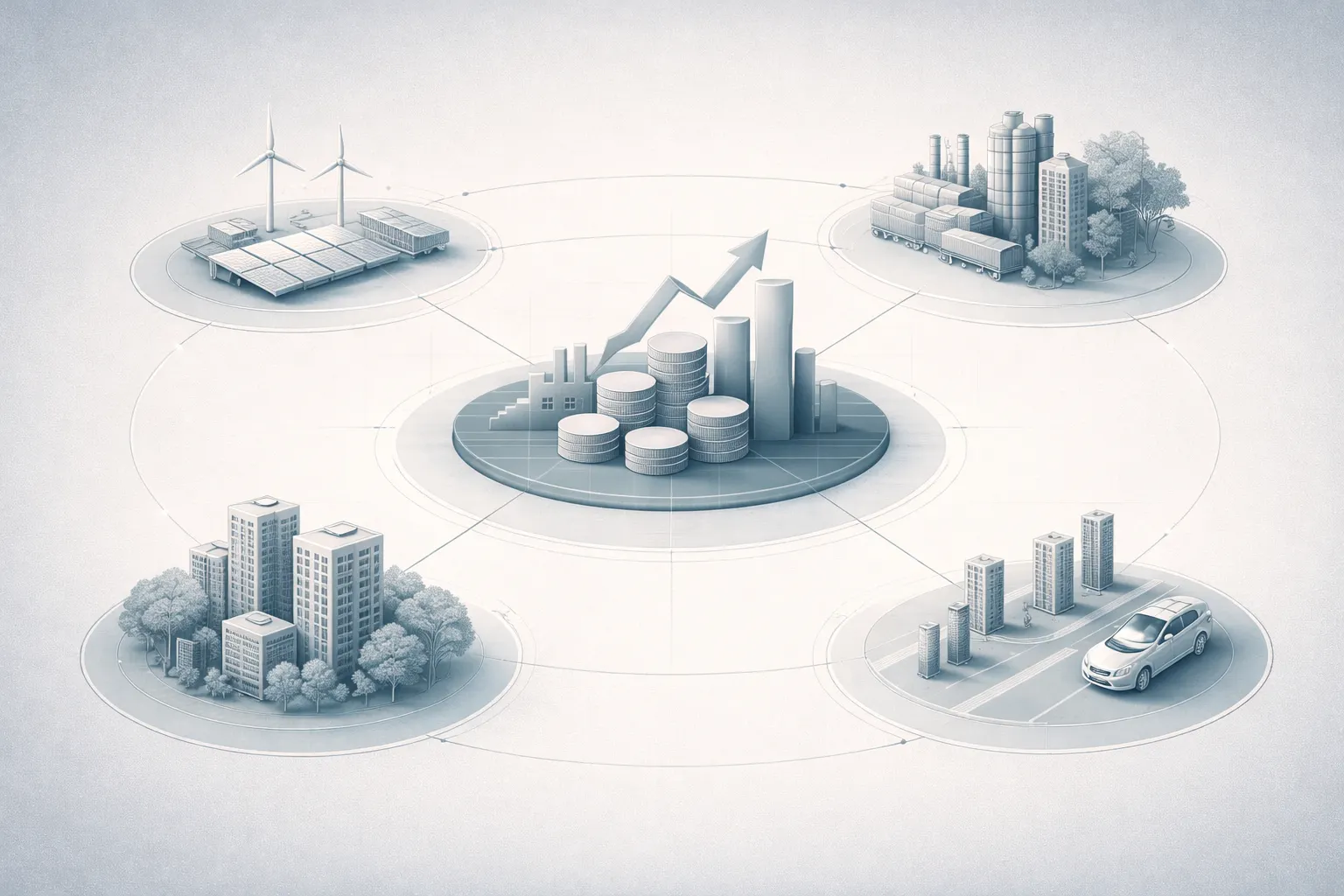
The Transition Backbone
At the centre of the transition sits a backbone of real assets responsible for transforming how energy is produced, materials are processed, land is managed, cities operate, and transport systems function. These sectors are consistently identified by leading institutions as both the most emissions-intensive and the most capital-critical components of the global economy (IEA, 2025c; OECD, 2025; UNEP, 2025; World Bank, 2025).
What distinguishes the backbone from broader transition activity is economics. These assets absorb significant upfront investment, operate over multi-decade horizons, and exhibit risk profiles that can be underwritten and structured.
Around this backbone sits a secondary layer of transition-related activity – software, advisory services, optimisation tools, and consumer solutions – whose economics ultimately depend on the capacity, cost, and reliability of the physical systems upstream. Capital deployed into the backbone sets the constraints for everything that follows.
Renewable Energy Systems
Renewable energy assets’ economic value lies not in generation technology itself, but in the ability to reliably deliver metered electricity over long operating lives. Revenue is earned through legally binding offtake arrangements, such as power purchase agreements, or through participation in regulated wholesale electricity markets (EPA, 2025a; EPA, 2025b; Enlitia, 2025). In both cases, cash flows are governed by defined market rules and settlement mechanisms. Where merchant exposure exists, it is usually partial and deliberately structured.
Risk is concentrated in development, permitting, construction, and grid connection. Once commissioned, operating risk falls materially and cash flows stabilize. Over time, these assets behave like amortising infrastructure rather than growth businesses(Gatzert, N. and Kozub, T., 2015; Kearney, 2024).
As the sector matures, returns increasingly depend on grid access, system positioning, and integration with storage rather than capacity additions alone. Rising electricity demand from data centres, transport electrification, and industry is reinforcing long-term volume fundamentals, but capital is becoming more selective as pricing discipline tightens (IEA, 2025b).
Core Materials and the Circular Economy
Core materials and circular economy assets earn revenue through a combination of processing fees for handling waste streams and the sale of recovered materials into commodity markets (KPMG, 2019; Moloney, P. and Cook, G.(2022). Unlike power assets, output pricing is market-exposed, while input volumes depend on feedstock availability and logistics. As a result, cash flows are operationally and cyclically exposed.
Risk spans the full asset lifecycle. Margins depend on throughput, efficiency, and prevailing commodity prices. Scale and platform integration are therefore critical, allowing operators to secure feedstock, optimise logistics, and smooth earnings volatility (European Investment Bank, 2023; AlMashaqbeh, S. and Munive-Hernandez, J.E., 2023; Gennari, F., 2024). Capital typically participates through platform strategies rather than single-asset ownership, reflecting the importance of operational leverage over asset-level yield.
Land & Resource Management
Land and resource management assets derive revenue from production, leasing, or land appreciation, with emerging contributions from ecosystem service markets such as biodiversity credits, carbon removals, and water-quality outcomes (Ecosystem Services Market Consortium, 2021). These markets remain uneven and jurisdiction-specific, but introduce optionality over long time horizons.
Cash flows are long-dated and sensitive to biological, climatic, and regulatory conditions. Risk is therefore diffuse and difficult to compress through leverage. These characteristics favour patient capital, while broader institutional participation remains selective. Growth in this sector is driven by improvements in land productivity, regenerative practices, and the gradual formalisation of nature-based markets. Monetisation remains early, but optionality increases as standards mature and demand for high-integrity outcomes rises (World Economic Forum, 2024).
Green Infrastructure
Green buildings and cities generate revenue through lease agreements, service charges, and, in some cases, district energy services. Cash flows are therefore linked to property market conditions rather than commodity prices. Risk is spread across acquisition, leasing, tenant demand, and asset management.
Green upgrades are increasingly a prerequisite for financing access and exit liquidity rather than a standalone return enhancer. Growth is concentrated in retrofitting existing building stock, tightening energy performance standards, and rising tenant preference for lower operating costs. Value accrues through avoided obsolescence, stronger occupancy, and preserved liquidity rather than yield expansion (Bienert, S., Wein, J., Spanner, M., Kuhlwein, H., Huber, V., Künzle, C., Ulterino, M., Carlin, D. & Arshad, M., 2022).
Mobility Infrastructure
Mobility assets earn revenue through usage fees, availability payments, concession agreements, or long-term service contracts. While some cash flows are contracted, long-term performance is dependent on utilisation and adoption rates. As a result, demand risk is material.
Public transport assets often rely on government counterparties, producing quasi-contracted revenues. Charging networks and logistics platforms depend on end-user demand, fleet adoption, and network density. Electric vehicles themselves are not revenue assets; the infrastructure that supports them is(Poole, R, 2024). Growth in mobility infrastructure is driven by fleet electrification, network densification, and integration with power systems rather than individual asset deployment (LaMonaca, S. & Ryan, L., 2022).
–
At éthica Capital and the GBC Group, this asset-level perspective informs how capital is structured and deployed across the transition backbone. We focus on dissecting revenue mechanisms, aligning investor risk retention with asset behaviour, and structuring capital to match lifecycle dynamics. This approach enables transition ambition to be translated into durable investment outcomes through disciplined asset selection, financing structures, and platform development.
Building on this foundation, the next article in the series will examine how different types of investors engage with the transition backbone in practice- how capital allocates across the lifecycle, what signals investors look for as risk shifts, and how participation varies across infrastructure, credit, private equity, and strategic capital. For further analysis of how these mechanics translate into investable strategies, readers can explore éthica Capital’s research, which examines asset-level economics, financing structures, transaction dynamics, and investor behaviour across core transition sectors.
Citations
AlMashaqbeh, S. and Munive-Hernandez, J.E. (2023) ‘Risk analysis under a circular economy context using a systems thinking approach’, Sustainability, 15(5), 4141. Available at: https://www.mdpi.com/2071-1050/15/5/4141 (Accessed: 27 January 2026).
Bhalla, K. (2025) World energy investment 2025 highlights electricity demand and energy security as new drivers. IIGCC, 10 June. Available at: https://www.iigcc.org/insights/world-energy-investment-2025-highlights-electricity-demand-and-energy-security-new-drivers (Accessed: 23 January 2026).
Bienert, S., Wein, J., Spanner, M., Kuhlwein, H., Huber, V., Künzle, C., Ulterino, M., Carlin, D. and Arshad, M. (2022) Managing transition risk in real estate: Aligning to the Paris Climate Accord. Wörgl, Austria: IIÖ – Institut für Immobilienökonomie & United Nations Environment Programme Finance Initiative (UNEP FI). Available at: https://www.unepfi.org/wordpress/wp-content/uploads/2022/03/Managing-transition-risk-in-real-estate.pdf (Accessed: 27 January 2026).
Crux Climate (2025) Understanding renewable energy project finance from start to finish. Available at: https://www.cruxclimate.com/insights/understanding-renewable-energy-project-finance (Accessed: 27 January 2026).
Enlitia (2025) Understanding capture prices in renewable energy markets. Available at: https://www.enlitia.com/resources-blog-post/capture-price-definition (Accessed: 27 January 2026).
Environmental Protection Agency (EPA) (2025a) Financing. US Environmental Protection Agency. Available at: https://www.epa.gov/green-power-markets/financing (Accessed: 27 January 2026).
EPA (2025b) Green power pricing. US Environmental Protection Agency. Available at: https://www.epa.gov/green-power-markets/green-power-pricing (Accessed: 27 January 2026).
Ecosystem Services Market Consortium / Ecosystem Services Market Research Consortium (2021) Markets for ecosystem services on public grazing lands: Assessment of potential services and considerations for a successful program. January. Available at: https://ecosystemservicesmarket.org/wp-content/uploads/2023/02/Markets-for-ecosystem-services-on-public-grazing-lands_ESMC-White-Paper.pdf (Accessed: 27 January 2026).
Gatzert, N. and Kosub, T. (2015) Risks and risk management of renewable energy projects: The case of onshore and offshore wind parks. Working Paper, Department of Insurance Economics and Risk Management, Friedrich-Alexander University Erlangen–Nürnberg (FAU).
Gennari, F. (2024) ‘Strategic risk-based approach for the circular economy’, European Journal of Business and Management Research, 9(3). Available at: https://eu-opensci.org/index.php/ejbmr/article/view/52294 (Accessed: 27 January 2026).
Global Market Insights Inc. (2025) Circular economy solutions market size, growth analysis, 2025–2034. Available at: https://www.gminsights.com/industry-analysis/circular-economy-solutions-market (Accessed: 19 January 2026).
International Energy Agency (IEA) (2025a) Global EV Outlook 2025. Paris: IEA. Available at: https://www.iea.org/reports/global-ev-outlook-2025 (Accessed: 18 January 2026).
IEA (2025b) Renewables 2025. Paris: IEA. Available at: https://www.iea.org/reports/renewables-2025 (Accessed: 18 January 2026).
IEA (IEA) (2025c) World energy investment 2025. Paris: IEA. Available at: https://www.iea.org/reports/world-energy-investment-2025 (Accessed: 18 January 2026).
Kearney (2024) Unveiling the vulnerabilities: Unpacking risks in the renewable energy supply chain. 24 May. Available at: https://www.kearney.com/service/operations-performance/article/unveiling-the-vulnerabilities-unpacking-risks-in-the-renewable-energy-supply-chain (Accessed: 27 January 2026).
KPMG Advisory N.V., Copper8 and Kennedy Van der Laan (2019) Circular revenue models: Practical implications for businesses. White paper, 25 September. Available at: https://assets.kpmg.com/content/dam/kpmg/nl/pdf/2022/services/circular-revenue-models.pdf (Accessed: 27 January 2026).
LaMonaca, S. and Ryan, L. (2022) ‘The state of play in electric vehicle charging services – a review of infrastructure provision, players, and policies’, Renewable and Sustainable Energy Reviews, 154, 111733. Available at: https://www.sciencedirect.com/science/article/pii/S1364032121010066 (Accessed: 27 January 2026).
Moloney, P. and Cook, G. (2022) Circular economy business models explained. Ramboll, 22 August. Available at: https://www.ramboll.com/en-us/insights/resource-management-and-circular-economy/circular-economy-business-models-explained (Accessed: 27 January 2026).
Organisation for Economic Co-operation and Development (OECD) (2025) Guidance on Transition Finance. Paris: OECD Publishing. Available at: https://www.oecd.org/en/publications/oecd-guidance-on-transition-finance_7c68a1ee-en.html (Accessed: 27 January 2026).
Poole, R. (2024) Surface transportation news: Trends in infrastructure finance and public-private partnerships. Reason Foundation, 7 May. Available at: https://reason.org/transportation-news/trends-in-infrastructure-finance-and-public-private-partnerships/ (Accessed: 27 January 2026).
Reuters (2026) Wind and solar beat fossil fuels in EU power mix in 2025. London: Reuters, 21 January. Available at: https://www.reuters.com/sustainability/climate-energy/wind-solar-beat-fossil-fuels-eu-power-mix-2025-energy-think-tank-says-2026-01-21/ (Accessed: 22 January 2026).
United Nations Environment Programme (UNEP) (2025) Global Environment Outlook 7: A Future We Choose. Nairobi: UNEP. Available at: https://www.unep.org/resources/global-environment-outlook-7 (Accessed: 27 January 2026).
World Bank (2025) Clean Cities, Bright Futures: Accelerating Investment and Reforms in Solid Waste Management in Developing Countries. Washington, DC: World Bank. Available at: https://www.worldbank.org/en/results/2025/04/30/clean-cities-bright-futures-accelerating-investment-and-reforms-in-solid-waste-management-in-developing-countries (Accessed: 27 January 2026).
World Economic Forum (WEF) (2024) Investing in natural capital: Innovations supporting much-needed financing for nature. Geneva: WEF. Available at: https://www3.weforum.org/docs/WEF_Investing_in_Natural_Capital_2024.pdf (Accessed: 27 January 2026).
WEF (2025) Global energy 2026: Growth, resilience and competition. Geneva: WEF. Available at: https://www.weforum.org/stories/2025/12/global-energy-2026-growth-resilience-and-competition (Accessed: 18 January 2026).
World Resources Institute (WRI) (2025) State of clean energy, in 10 charts. Washington, DC: WRI. Available at: https://www.wri.org/insights/state-clean-energy-charted (Accessed: 18 January 2026).



.png)